

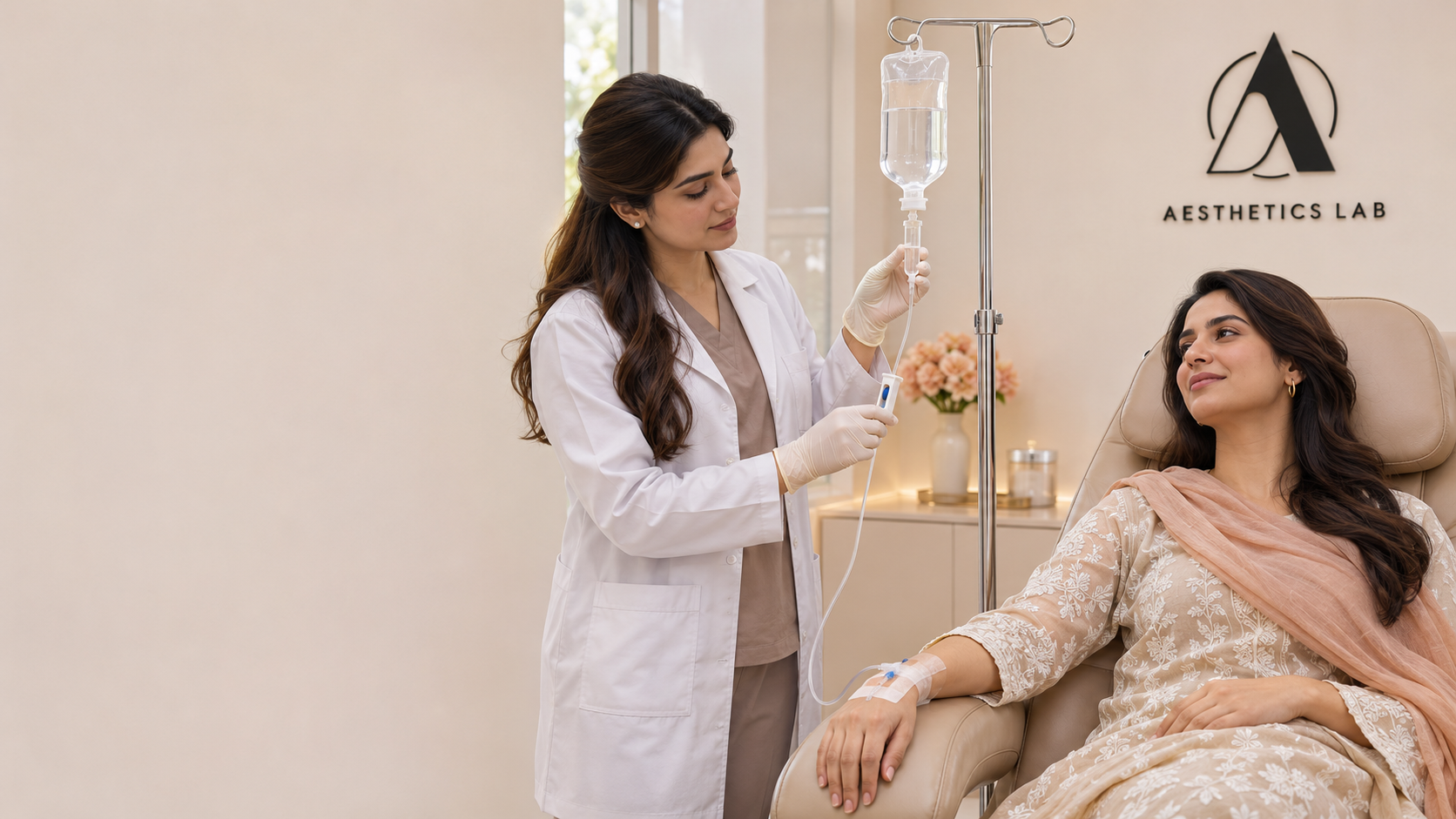
If you are researching skin whitening drips, you may have seen the same treatment advertised as a glutathione drip, whitening injection or IV glow therapy. Before choosing a package, it helps to understand what these names mean, what the evidence supports and which questions to ask.
At Aesthetics Lab, a consultation is an opportunity to discuss the concern behind your search, whether that is uneven pigmentation, tanning, dryness or acne marks. These concerns deserve different assessments rather than a single promise of lighter skin.
Quick answers
- A drip and an injection are administration methods. The exact ingredients and route matter more than the marketing name.
- Evidence does not establish reliable, permanent whitening from IV glutathione. A systematic review advised against its use for cosmetic skin lightening because of insufficient efficacy and adverse effects.
- Medical supervision cannot guarantee safety. Serious reactions and product-quality problems have been reported.
- Match treatment to the concern. Pigmentation, scarring and dehydration are different problems.
What are skin whitening drips and injections?
Skin whitening drips and injections are marketing terms for treatments that often contain glutathione, sometimes with vitamin C or other ingredients. A drip delivers a solution slowly into a vein. “Injection” may refer to different routes. Neither label establishes effectiveness, safety or permanent skin lightening.
Glutathione is an antioxidant naturally present in the body. Its biological role does not, by itself, demonstrate that an additional infusion produces a meaningful cosmetic benefit. Studies of oral or topical preparations also cannot automatically establish the effects of an injectable formulation.
If you are comparing IV Vitamin Glow Drips at Aesthetics Lab, ask for the current ingredient list, proposed administration method and clinical rationale. Do not assume that every treatment containing the word “glow” has the same formulation.
Whitening drip vs injection: what is the difference?
A whitening drip is a type of intravenous infusion. An injection may be given into a vein or use another route, depending on the product. Ask the clinic to explain its terminology before comparing prices or expected outcomes.
| Feature | IV drip | Injection |
|---|---|---|
| Administration | A solution is infused into a vein through a cannula. | The term may describe different routes; confirm which one is proposed. |
| Ingredients | May contain glutathione and additional ingredients. | Depend on the specific product and prescription. |
| Appointment | Includes preparation, administration and monitoring. | Time and monitoring depend on the route and formulation. |
| Whitening evidence | IV delivery does not establish a reliable cosmetic benefit. | The word “injection” does not establish superior results. |
| Price comparison | Ask what the complete clinic appointment includes. | Distinguish the vial price from the supervised service. |
Faster entry into the bloodstream is not the same as proven improvement in skin pigmentation. A useful comparison considers the evidence for the exact product, route and claimed outcome.
Do skin whitening drips actually work?
Evidence supporting IV glutathione for cosmetic skin lightening is limited. A systematic review published online in 2024 and in a 2025 journal issue identified only one placebo-controlled IV study. The review advised against IV glutathione for this purpose because of insufficient efficacy and side effects.
In that Pakistani study, 6 of 16 treatment completers showed improvement, compared with 3 of 16 receiving placebo. The difference did not meet the conventional threshold for statistical significance (p = 0.054). Improvement diminished after treatment stopped. The study also reported abnormal liver tests and anaphylaxis among participants withdrawn from treatment.
Its small sample, withdrawals and combination formulation limit what can be concluded. The treatment percentage should not be advertised as your personal chance of success.
Are whitening drips and injections safe?
Cosmetic infusions are not risk-free. Risk depends on the ingredients, dose, product quality, preparation, administration and the patient’s health. A qualified clinician and sterile setting are important, but neither removes every possible reaction.
In August 2026, the US FDA reported serious illnesses after compounded injectable glutathione was prepared using supplement-grade material. Reported symptoms included fever, chills, dizziness, low blood pressure and shock-like illness. This warning concerned specific product-quality problems; it should not be described as proof that every product has identical contamination.
Seek urgent medical care for breathing difficulty, facial swelling, fainting or fever with chills during or after an infusion. Tell the treating team immediately if you feel unwell.
Before considering any treatment, disclose medicines, previous reactions, pregnancy or breastfeeding, and relevant medical conditions. Ask which ingredient-specific precautions apply to you. A test dose or normal blood test cannot guarantee that a later reaction will not occur.
Are whitening injections approved in Pakistan?
Ask the clinic to identify the exact product and provide its registration details and authorised product information. DRAP’s public database includes information such as the product name, formulation, manufacturer and registration number. A database entry alone should not be presented as evidence that cosmetic skin whitening is an approved indication.
Regulatory statements must also identify the country. The CDC states that there are no FDA-approved glutathione products in the United States; this is a US statement, not a substitute for checking the status of a particular product in Pakistan.
Which alternatives may better match your skin concern?
Start with an assessment of what you want to improve. A dermatologist can distinguish melasma or another pigment disorder from dryness, congestion or acne scarring.
| Your main concern | What to discuss |
|---|---|
| Dryness or congestion | Skincare and HydraFacial for cleansing and hydration, if suitable. |
| Acne scars or uneven texture | Microneedling for selected acne scars and texture concerns, following assessment. |
| Melasma or persistent dark patches | A diagnosis-based plan including sun protection and appropriate topical treatment; selected procedures may be considered by a dermatologist. |
| Pigmented spots | A laser therapy consultation to establish whether a particular device and protocol are appropriate. |
| Hydration or skin-quality goals | Skin booster and Profhilo options, which are different from IV glutathione and have their own indications and risks. |
For melasma, the American Academy of Dermatology describes treatment based on sun protection, topical medicines and, for selected patients, procedures. A whitening drip should not replace a diagnosis-based plan.
What do whitening drips and injections cost in Pakistan?
Compare complete services rather than treatment names alone. Ask whether the quotation covers consultation, the exact formulation, sterile supplies, administration, monitoring and follow-up. Any tests or additional treatment should be explained separately.
For a detailed breakdown, read our glutathione drip cost in Pakistan guide. Confirm current prices and inclusions with your chosen branch. A higher price or imported label does not establish better cosmetic outcomes.
What should you ask before considering treatment?
- What is causing my skin concern?
- What are the exact ingredients and administration route?
- What evidence supports the proposed outcome?
- How are the product and its source verified?
- What risks and alternatives apply to me?
- How will benefit, adverse effects and reasons to stop be assessed?
Frequently asked questions
1. Is a whitening drip better than a whitening injection?
Neither label proves better results. A drip is an intravenous infusion, while “injection” may refer to another administration method. Ask about the exact formulation and route. Bloodstream delivery does not establish superior whitening, and the evidence does not support promising a reliable cosmetic outcome from IV glutathione.
2. Are skin whitening drip results permanent?
Permanent whitening from IV glutathione has not been established. In a small Pakistani placebo-controlled study, improvement diminished after treatment stopped. Avoid promises of guaranteed lighter shades or permanent results. Ask whether your concern is melasma, tanning or post-acne pigmentation, because each needs an appropriate assessment.
3. How many whitening drip sessions do I need?
There is no established cosmetic course that guarantees effective, lasting skin lightening. Advertised packages of six, ten or twenty sessions should not be treated as a universal medical standard. Discuss the evidence, suitability, possible risks and alternatives before purchasing a course or agreeing to maintenance sessions.
4. What are the side effects of whitening drips and injections?
Adverse effects can include nausea, dizziness, allergic reactions and problems related to product quality or administration. Serious reactions have been reported. The risks depend on the formulation and your health. Breathing difficulty, facial swelling, fainting or fever with chills during or after treatment require urgent medical assessment.
5. What is the whitening drip price in Pakistan?
Prices vary by formulation, administration method, clinic and included care. Request an itemised quotation covering the product, consultation, any tests, administration and follow-up. At Aesthetics Lab, confirm current pricing with your preferred branch and read our glutathione drip cost guide before comparing packages.
6. Can glutathione drips replace treatment for melasma?
No. Melasma needs a dermatologist’s assessment and a plan suited to your skin. Sun protection and appropriate topical medicines are commonly central to treatment, with procedures considered for selected patients. Do not replace prescribed care with a whitening package or assume that a drip will clear persistent patches.
7. Is Profhilo the same as a whitening injection?
No. Profhilo is a hyaluronic-acid-based injectable treatment discussed for skin hydration and quality. Glutathione infusions involve different ingredients, administration and treatment goals. They should not be presented as interchangeable “glow injections.” Ask your clinician which concern a proposed treatment addresses and what its specific benefits and risks are.
8. Does a higher-priced whitening drip mean better results?
No. A higher price does not establish effectiveness or safety. Compare the exact product, proposed clinical purpose, registration information, administration and monitoring.
Ask for an itemised quotation and evidence supporting the claimed outcome. Decisions should be based on medical suitability and reliable information, rather than price or an imported label.
Discuss your skin concerns with Aesthetics Lab
If you are exploring whitening drips and injections, begin with a consultation to understand your concern and discuss the evidence, alternatives and realistic expectations.
Book a consultation: WhatsApp +92 311 1184224
Locations: Lahore, Islamabad and Faisalabad
Website: www.aestheticslab.pk
Leave a Reply